When Your Commute Is Longer Than Most People's Weekend
Annual mileage is not a throwaway question on an application. Insurance Code section 1861.02(a) lists the mandatory rating factors in decreasing order of importance: the driver's safety record first, the number of miles driven annually second, and years of driving experience third. In California, how far you drive is written into law as the second most important thing about you as a risk.
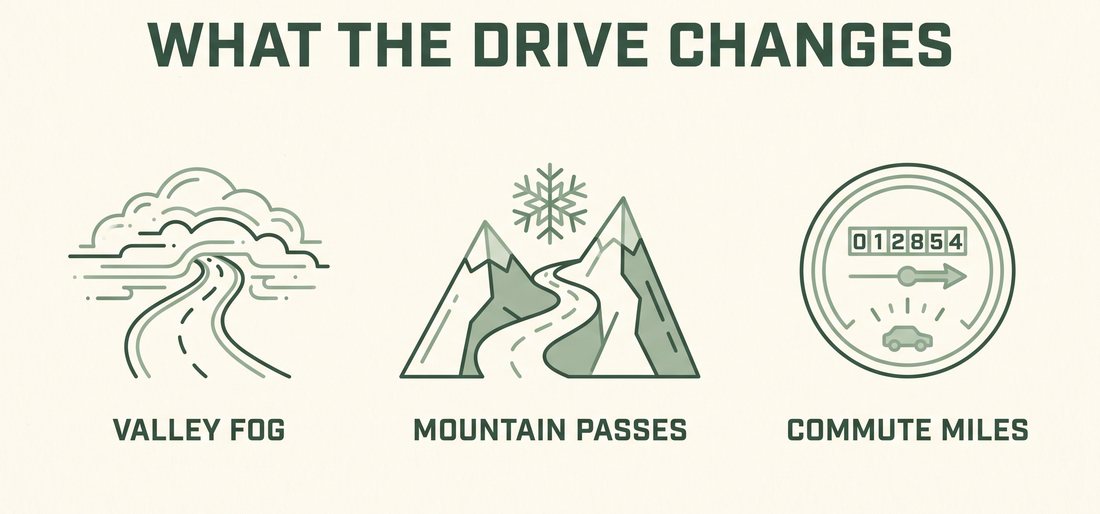
Why this hits valley drivers differently
Housing and work have not stayed in the same places here. People live in Tracy, Manteca, Patterson, Los Banos, Merced or Turlock and work somewhere considerably further west or north. A ninety-mile round trip five days a week is a commute a lot of valley households simply accept, and it puts a driver into a mileage band that a city driver never approaches. The question is not whether that is fair; the question is how to answer it accurately, because an inaccurate answer is a problem waiting at the wrong moment.
Before you buy, the guide to new Job, new Commute is worth ten minutes.
How to actually work out your number
Guessing produces two kinds of error and both cost you something. Here is a method that takes five minutes:
- Measure one round trip door to door, including any regular detour — the school drop, the store on the way home.
- Multiply by the days you actually go in. Four days is not five. Count the real pattern.
- Multiply by working weeks, which is not 52. Subtract vacation and holidays honestly.
- Add everything else — weekend driving, family trips, the run to the coast, the drive to see relatives.
- Sanity check against the odometer. Two service records a year apart give you the real answer better than any estimate.
The overstated number nobody corrects
People round up, then keep the same figure for years after the job changed, the shift changed, or the household went to one commute instead of two. That is worth revisiting at renewal. The odometer settles it: two dated readings and simple arithmetic tell you what you actually drive now, not what you drove when you first bought the policy.
Understating it is the expensive mistake
Reporting a number well below your real driving is not a clever way to save. Carriers verify mileage in various ways depending on the company — odometer readings at service, information reported through vehicle telematics where the driver has enrolled, inspection at a claim. What happens when a reported figure does not match reality varies by carrier and by how far off it is, and none of the possibilities are good for you. It is a genuinely bad trade: a small saving now against an argument at the exact moment you need the policy to work.
What to do if the number is simply high
Say it plainly and shop it properly. Carriers weigh mileage differently from one another within the rules, which is the entire reason comparing more than one is worth the time. It is also worth asking whether anything about the pattern can genuinely change — a compressed schedule, a vanpool, a second vehicle taking the long trips while a low-mileage car handles the rest. Those are real changes to the risk, not paperwork tricks, and they are the honest way to move the number.
Give us your real mileage and we will quote it across carriers rather than around it.
Get this quoted for your situation
Free quotes from multiple carriers, prepared by a licensed California agent. Two minutes, no obligation.
Get My Free QuoteMore of what callers ask
What counts as annual mileage?
Every mile the vehicle is driven in a year, not just commuting. Include weekends, errands and trips, and check the total against two dated odometer readings if you can.
Will a long commute keep me from getting covered?
No. High mileage is a rating factor, not a disqualification, and California law lists annual miles as the second mandatory factor after driving record. The practical response is to report it accurately and compare carriers.
Should I lower my reported mileage to save money?
No. Carriers have ways of checking, and a figure that does not match reality can create a problem at claim time. If your driving genuinely changed, update the number and ask for the policy to be re-rated.